Dawn Of The Discs: How Optical Media Revolutionized Entertainment And Data Storage
Have you ever wondered how we transitioned from massive vinyl records and clunky cassette tapes to the sleek, shiny discs that transformed our entertainment experience? The dawn of the discs marked a pivotal moment in technology history, revolutionizing how we consume music, movies, and store data. From the humble beginnings of laser technology to the sophisticated Blu-ray discs of today, this journey has been nothing short of remarkable.
The evolution of optical discs didn't happen overnight. It was a gradual process of innovation, experimentation, and refinement that spanned several decades. This article explores the fascinating story of how discs became the dominant medium for entertainment and data storage, examining the key milestones, technological breakthroughs, and cultural impact that shaped this digital revolution.
The Birth of Optical Technology: From Laser to Disc
The foundation of disc technology lies in the invention of the laser in 1960. Scientists and engineers quickly recognized the potential of this focused beam of light for reading and writing information. Early experiments focused on creating a medium that could store data in a way that a laser could both read and write to it. This led to the development of the first optical storage prototypes in the early 1970s.
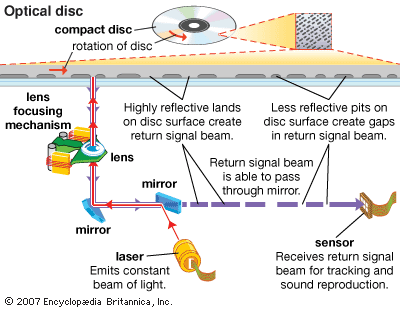
The breakthrough came when researchers discovered how to create a reflective surface with microscopic pits that could be read by a low-power laser. This technology formed the basis for what would become the compact disc. The first practical applications emerged in the music industry, where engineers sought a replacement for vinyl records that wouldn't degrade with repeated playbacks.
The Compact Disc Revolution
In 1982, Sony and Philips jointly launched the first commercial compact disc, forever changing the music industry. The CD offered several advantages over vinyl records: superior sound quality, durability, and the ability to skip directly to any track. Music enthusiasts quickly embraced this new format, and by the late 1980s, CDs had become the dominant music medium.
The success of audio CDs inspired developers to explore other applications. Computer companies recognized the potential for data storage, leading to the development of CD-ROMs (Compact Disc Read-Only Memory) in the mid-1980s. These discs could store vast amounts of information - up to 700 MB, equivalent to hundreds of floppy disks.
Video Formats: From LaserDisc to DVD
While CDs were conquering the music world, another optical format was emerging for video content. The LaserDisc, introduced in 1978, was the first commercial optical video disc format. Although it offered superior video and audio quality compared to VHS tapes, its high cost and large size limited its mainstream adoption.
The real breakthrough in video discs came with the DVD (Digital Versatile Disc) in 1995. DVDs combined the benefits of CDs with video capabilities, offering better quality than VHS, more storage capacity, and the convenience of random access. The format war between DVD and its competitor, Divx, was won by DVD, which went on to become the standard for home video entertainment.
The Digital Age: Blu-ray and Beyond
As high-definition content emerged, the need for greater storage capacity led to the development of Blu-ray Discs in the early 2000s. Blu-ray technology uses a blue-violet laser instead of the red laser used in DVDs, allowing for much smaller pits and therefore greater data density. A single-layer Blu-ray disc can hold 25 GB, while dual-layer discs can store 50 GB.
The introduction of Blu-ray coincided with the rise of high-definition televisions and the demand for better video quality. Blu-ray discs could store full HD movies with uncompressed audio, providing a cinema-quality experience at home. The format also supported advanced features like interactive menus and bonus content.
Impact on Entertainment and Data Storage
The dawn of the discs fundamentally transformed how we interact with media. For music lovers, CDs offered portability and durability that vinyl could never match. Movie enthusiasts gained access to bonus features, director's commentaries, and superior picture quality. For businesses and consumers alike, optical discs provided a reliable way to back up and transport large amounts of data.
The cultural impact extended beyond just the technology itself. The packaging of CDs and DVDs created new opportunities for album artwork and movie marketing. Music stores transformed into multimedia retailers. The ability to easily create mix CDs changed how people shared music with friends.
The Decline and Legacy of Optical Discs
Despite their revolutionary impact, optical discs have faced challenges in the 21st century. The rise of digital downloads, streaming services, and USB flash drives has reduced the demand for physical media. Many modern laptops no longer include optical drives, and streaming platforms like Netflix and Spotify have changed how people access entertainment.
However, optical discs remain relevant in several areas. Many people still prefer physical media for collecting movies and music, valuing the ownership and quality it provides. Blu-ray remains the preferred format for high-quality home video. Additionally, optical discs offer advantages for archival storage, as they're not susceptible to magnetic interference and can last for decades when properly stored.
The Future of Disc Technology
While streaming dominates current trends, research continues into next-generation optical storage. Holographic storage and 5D optical data storage promise to dramatically increase capacity while maintaining the durability benefits of traditional discs. These technologies could store terabytes of data on a single disc, potentially reviving interest in optical media for archival purposes.
The gaming industry continues to support optical discs, with modern consoles using Blu-ray technology to deliver high-quality games with extensive content. As games become more complex and detailed, the need for high-capacity physical media remains relevant.
Conclusion
The dawn of the discs represents one of the most significant technological revolutions of the late 20th century. From the first CDs to modern Blu-ray discs, optical media transformed entertainment, data storage, and how we interact with digital content. While the dominance of physical media has waned in recent years, the legacy of this technology continues to influence how we consume and store information.
As we look to the future, the principles established during the dawn of the discs - the importance of quality, convenience, and capacity - remain relevant. Whether through traditional optical discs or emerging technologies, our desire for reliable, high-quality media storage and playback continues to drive innovation. The journey that began with those first shiny discs has left an indelible mark on technology and culture, reminding us how a simple idea - using light to read information - can change the world.